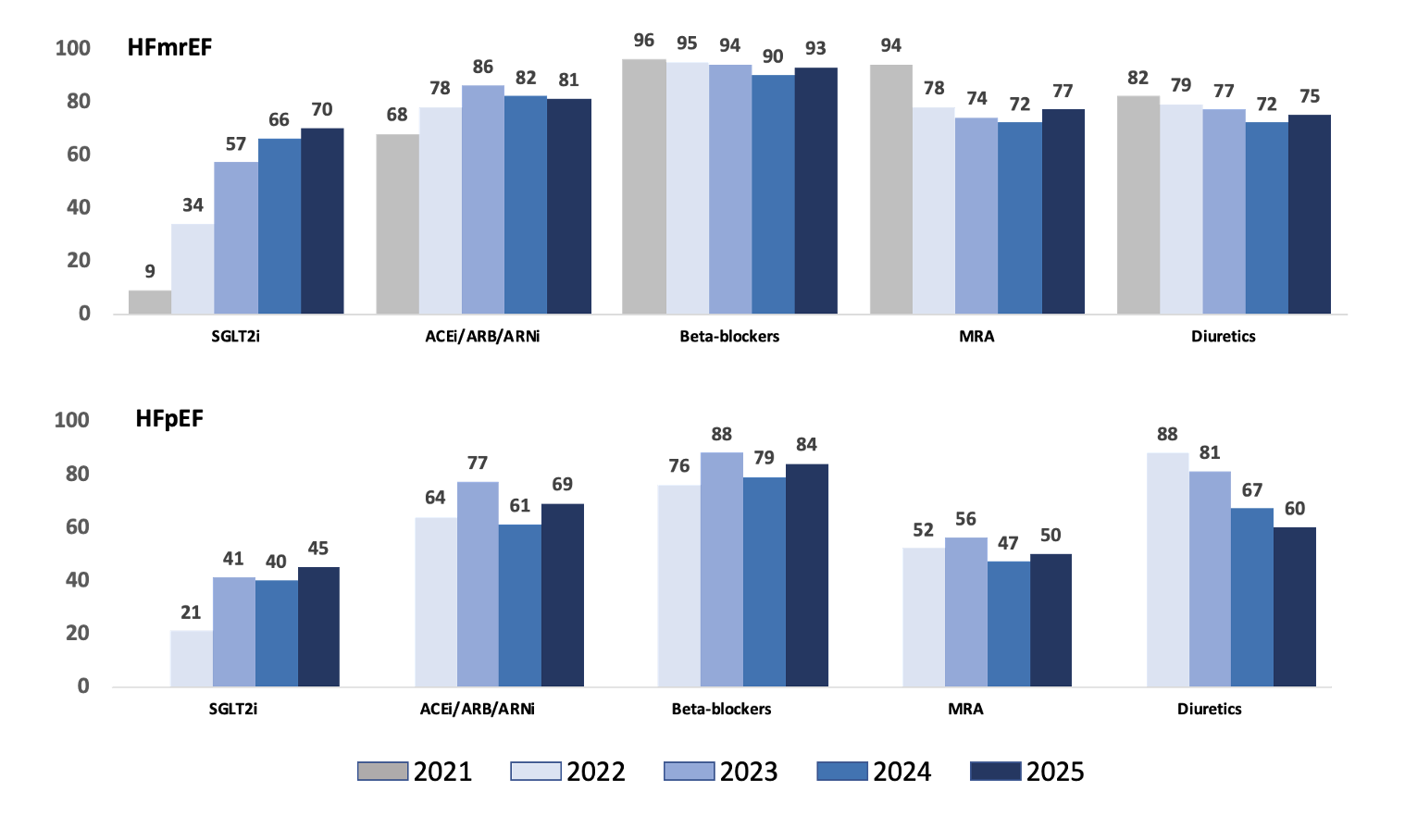
Background & Study Aim. In recent years, substantial progress has been achieved in the treatment of heart failure (HF), particularly in patients with reduced ejection fraction (HFrEF). Among the objectives of the PONTE SC/SCA registry is the evaluation of adherence to guideline-recommended therapies through both prospective and retrospective analyses. The aim of this study was to assess trends in therapy optimization over recent years, with particular focus on the use of angiotensin-converting enzyme inhibitors (ACEi), angiotensin receptor blockers (ARB), angiotensin receptor–neprilysin inhibitors (ARNI), beta-blockers, mineralocorticoid receptor antagonists (MRA), and sodium–glucose co-transporter 2 inhibitors (SGLT2i). Methods and Results. Between January 2024 and September 2025, 1,203 patients were enrolled, including 496 with heart failure with reduced ejection fraction (HFrEF). In this population, a retrospective analysis of clinical assessments was conducted for 83 patients in 2021, 244 in 2022, and 297 in 2023, alongside a prospective analysis including 972 patients in 2024 and 643 in 2025. As shown in the figure, a significant increase in the prescription rates of SGLT2i and quadruple therapy was observed, while prescription rates of the other pharmacological classes remained largely stable. Conclusions. The PONTE SC/SCA registry demonstrates a favorable trend toward optimization of medical therapy in patients with HFrEF. These findings highlight the quality of care provided by participating centers and confirm the value of the registry as a tool for analyzing and improving diagnostic and therapeutic pathways in heart failure.