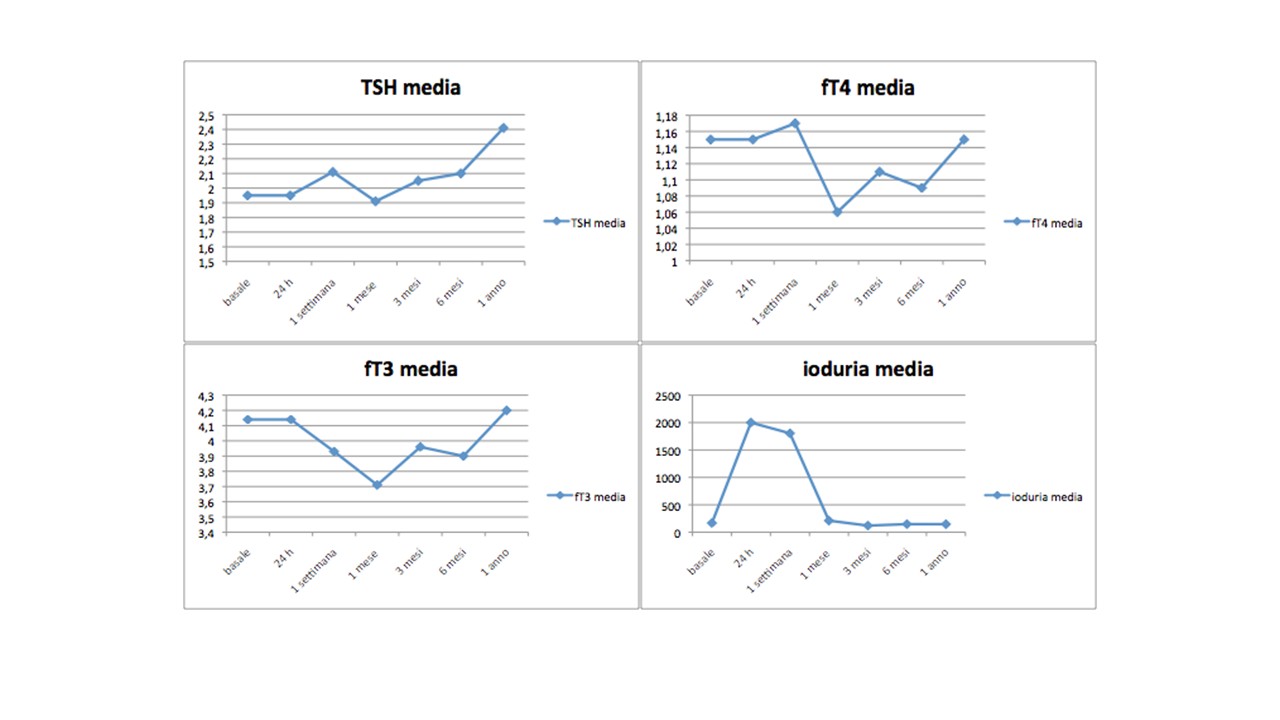
Introduction: During coronary CT scan, an overload of iodine (15-37 g) is administered by the intravenous contrast mean (ICM) injection. For this reason, international guidelines (ESUR) recommend caution to limit the risk of iatrogenic thyrotoxicosis only in patients with known thyroid disease. After ICM administration, iodine stores remain elevated for up to 4–8 weeks due to its high affinity to plasma proteins. The persistence of iodine overload could alter myocardial contractility as a result of the impaired thyroid metabolism. Aim of the study: 1. Assess the presence of thyroid dysfunction in a population of cardiac patients without known thyroid disease, admitted for coronary CT angiography. 2.Evaluate the temporal changes in thyroid metabolism and urinary iodine excretion during the 12 months after the administration of ICM. Materials and methods: The study enrolled 14 clinically euthyroid adult patients who perform coronary CT scans. The patients were evaluated by urinary iodine concentration and thyroid function parameters before the CT scan and after 24 hours, 7 – 30 days, and after 3-6-12 months. Results: All patients showed a dramatic increase of urinary iodine at 24 h (>2000 µg/L) until 1 week; after 1 month the urinary iodine started to decrease to normal values (mean ± SD=211±128 µg/L). The patients with reduced basal urinary iodine concentration showed at 6 months, superimposable value. The TSH value showed an increase above the normal range in 3 patients with a peak at 1 week (> 4 mUI/L). In the others, the TSH value, always in the normal range, showed a not significant increase with the maximum value at 1 week (1.95±0.82 vs 2.95±1.8 mUI/L p=0.07). The thyroid hormones showed an inverse physiological modification compared to TSH value with a maximum decrease at 1 week (fT3 4.14±0.59 vs 3.71±0.65 ng/L, fT4 1.14±0.16 vs 1.06±0.2ng/dL, p=ns). All thyroid function parameters showed values in the normal range after 1 month. Conclusions: According to the recent guidelines, thyroid hormone dosage is not recommended in all patients who perform CT scan with ICM. Our study demonstrates that the iodine overload alters thyroid hormones concentration and urinary iodine excretion mostly after 1 month and it could be dangerous for patients affected by heart diseases. Further studies should better investigate thyroid metabolism in this susceptible group of patients.