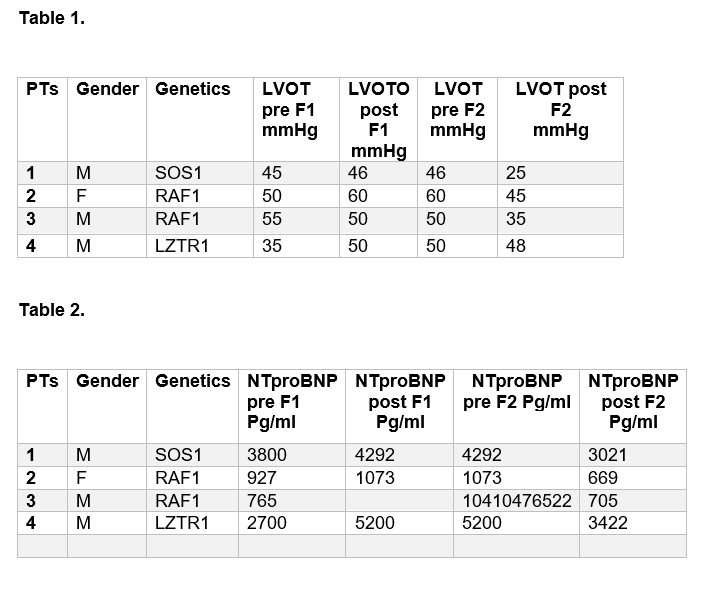
Background and aim: Obstructive hypertrophic cardiomyopathy (oHCM) is a common cause of heart failure in children and is often associated with RASopathies, such as Noonan Syndrome (NS). High-dose beta blockers remains the first-line option in patients with OHCM. In this case series, we aim to describe the effect of high-dose of Nadolol on left ventricular outflow tract( LVOT) gradient, NTproBNP levels and functional class. Methods: We report four pediatric patients (mean age 10 years) with oHCM and NS: two carrying RAF1 mutations, one with a SOS1 mutation, and one with a LZTR1 mutation. Initially three patients were treated with high-dose propranolol (mean dose 7,2 mg/kg/die) and one with bisoprolol (0,5 mg/kg/die). Clinical evaluations were performed at baseline and after 6 months, including measurements of LVOT gradient, NTproBNP levels, and Ross/NYHA functional class. Subsequently patients were switched to nadolol at a median dose of 2,2 mg/kg/die . Follow-up assessments were conducted after an additional 6 months. Results: At baseline, all patients exhibited elevated LVOT gradients (mean LVOT: 50 mmHg) and increased NTproBNP levels (mean NTproBNP: 3200 pg/mL), with Ross/NYHA class II. After 6 months of Propanolol or Bisoprolol therapy, mean heart rate target (HRT) was 77 bpm, there was no significant improvement in LVOT gradient (mean LVOT: 48 mmHg) or NTproBNP levels (mean: 3100 pg/mL). After transitioning to Nadolol, all patients showed a substantial reduction in HRT with a mean value of 60bpm, descrease in LVOT gradient (mean 25 mmHg, p=0,02),a marked decrease in NTproBNP levels (mean 1200 pg/mL, p=0,03), and an improvement in Ross class (mean class I). No adverse effects were reported during the follow-up period. Conclusions: Our findings suggest that high-dose of Nadolol is an effective treatment for oHCM in pediatric patients with NS. The switch from Propranolol/Bisoprolol to Nadolol resulted in significant improvements in clinical, instrumental and biochemical markers. This suggests that Nadolol may be a superior option for managing this condition, warranting further investigation into optimal dosing and long-term outcomes.