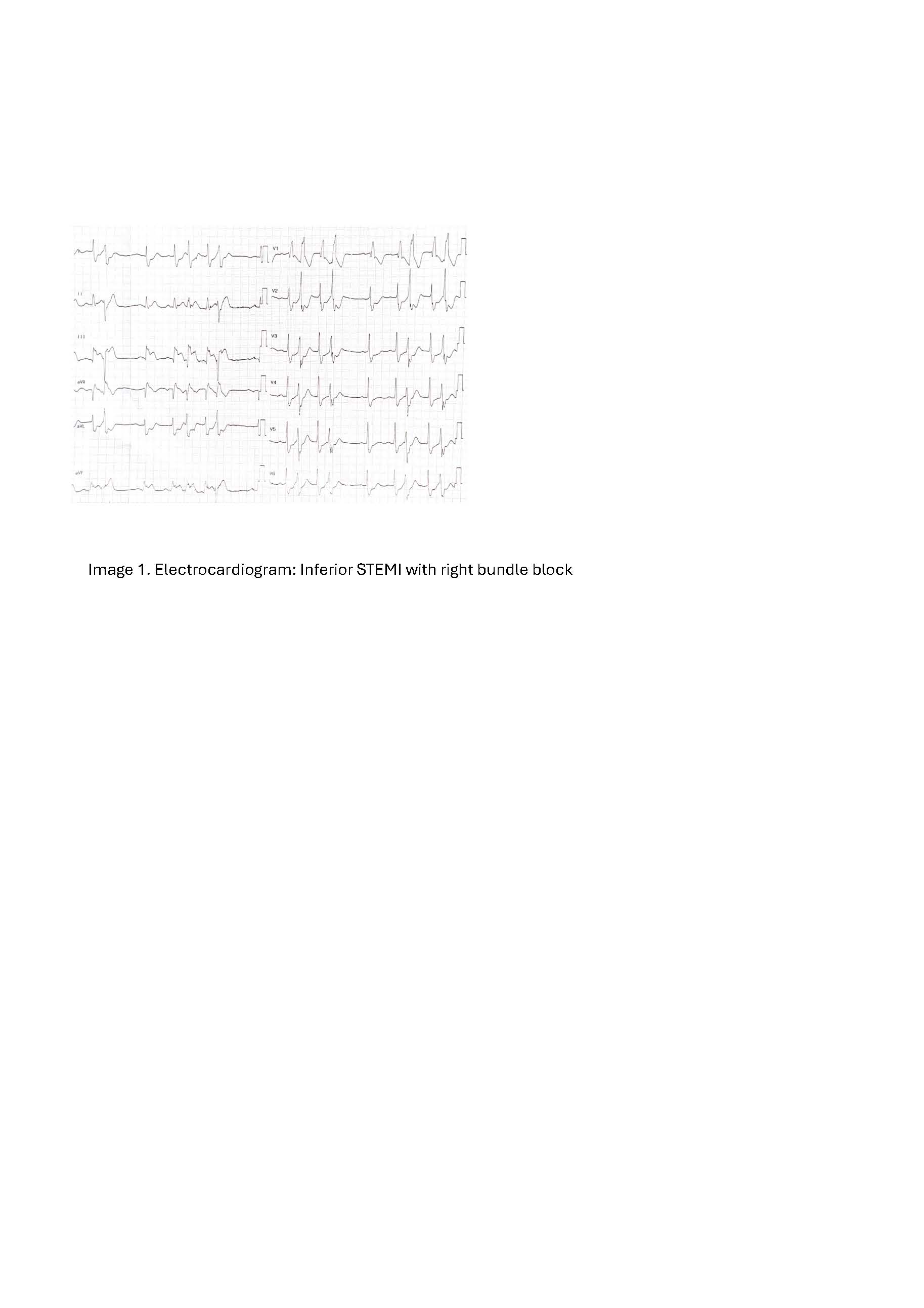
A 39–year–old man was admitted to emergency room for chest pain that had been ongoing for ten days. Blood pressure was 125/70 mmHg. Physical examination showed no signs of congestion or peripheral hypoperfusion Blood lactates level was 6,1 mmol/l. Electrocardiogram (image 1) revealed an inferior STEMI, right bundle block and ventricular premature beats. On echocardiography diffuse left ventricular hypokinesia with inferomedial basal akinesia and a left ventricular ejection fraction of 35%. The right ventricle showed preserved systolic function. On coronary angiography proximal occlusion of the left anterior descending artery (LAD) with angiographic features suggestive of recent thrombosis, critical proximal stenosis of the circumflex artery (CX), and occlusion of a dominant right coronary artery (RCA), also consistent with recent occlusion. A drug eluted stent was implanted on RCA. Due to the persistence of chest pain, angioplasty of the LAD was subsequently performed. During the LAD angioplasty, acute thrombosis of the circumflex artery was occoured, followed by cardiac arrest. Cardiopulmonary resuscitation maneuvers were initiated and once circulation was restored, hemodynamic support was provided with an intra–aortic balloon pump (IABP) and adrenaline infusion. Angioplasty both the LAD and LCx was completed, achieving good final TIMI flow. A new cardiac arrest due to a shockable rhythm occurred. There was no no–flow time, while total low– flow time was 50 minutes. Blood lactate levels was > 17 mmol/L. Veno–arterial extracorporeal membrane oxygenation (VA–ECMO) was initiated, and the patient was transferred to the intensive care unit (ICU) with hemodynamic support provided by adrenaline, VA–ECMO and IABP. After two weeks in ICU the patient was weaned from mechanical and pharmacological supports. The patient was subsequently transferred to a cardiovascular rehabilitation unit without neurological sequelae. Left ventricular ejection fraction at discharge was 50%, with only residual inferomedial basal akinesia. There is a growing interest and use of circulatory support systems in the intensive care community. European Resuscitation Council Guidelines suggest that VA–ECMO may be considered as a rescue therapy for selected adults with IHCA and OHCA when conventional CPR is failing to restore spontaneous circulation in settings where this can be implemented.