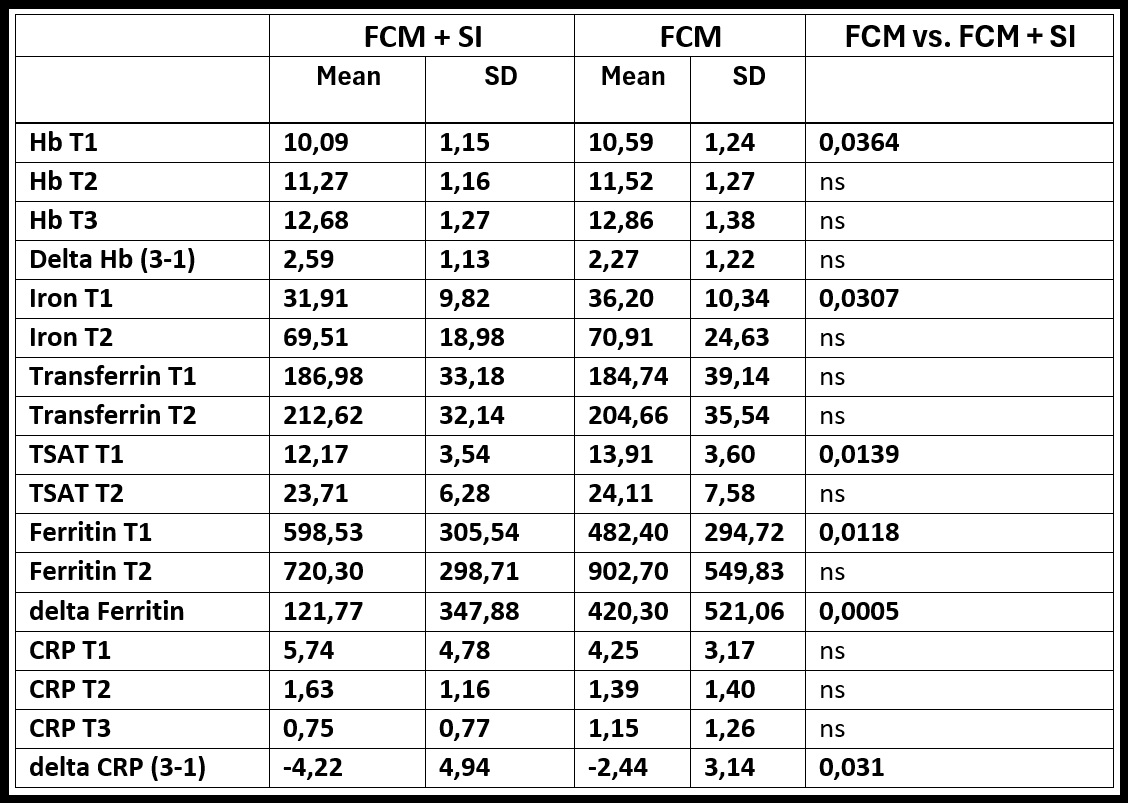
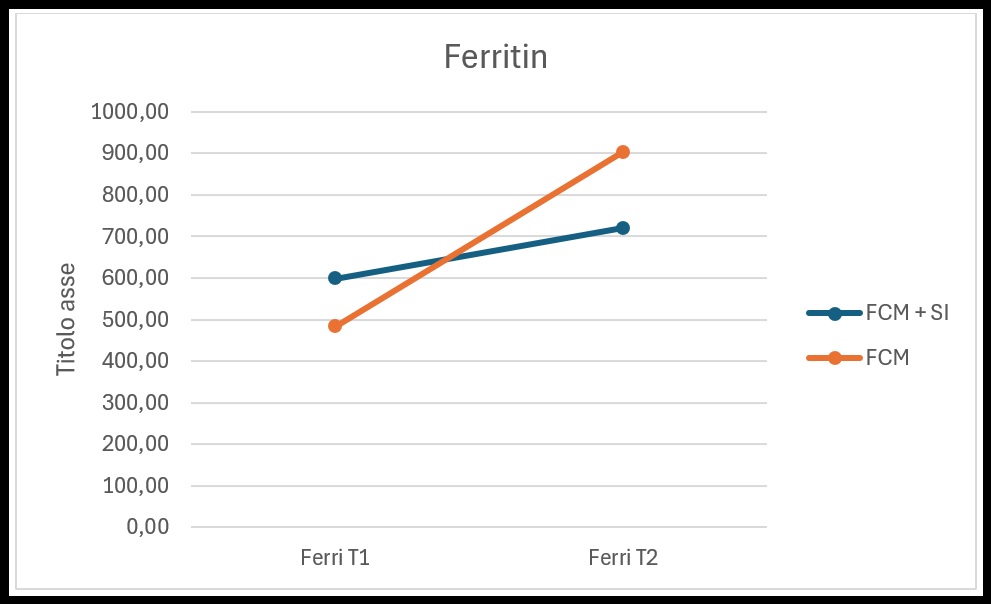
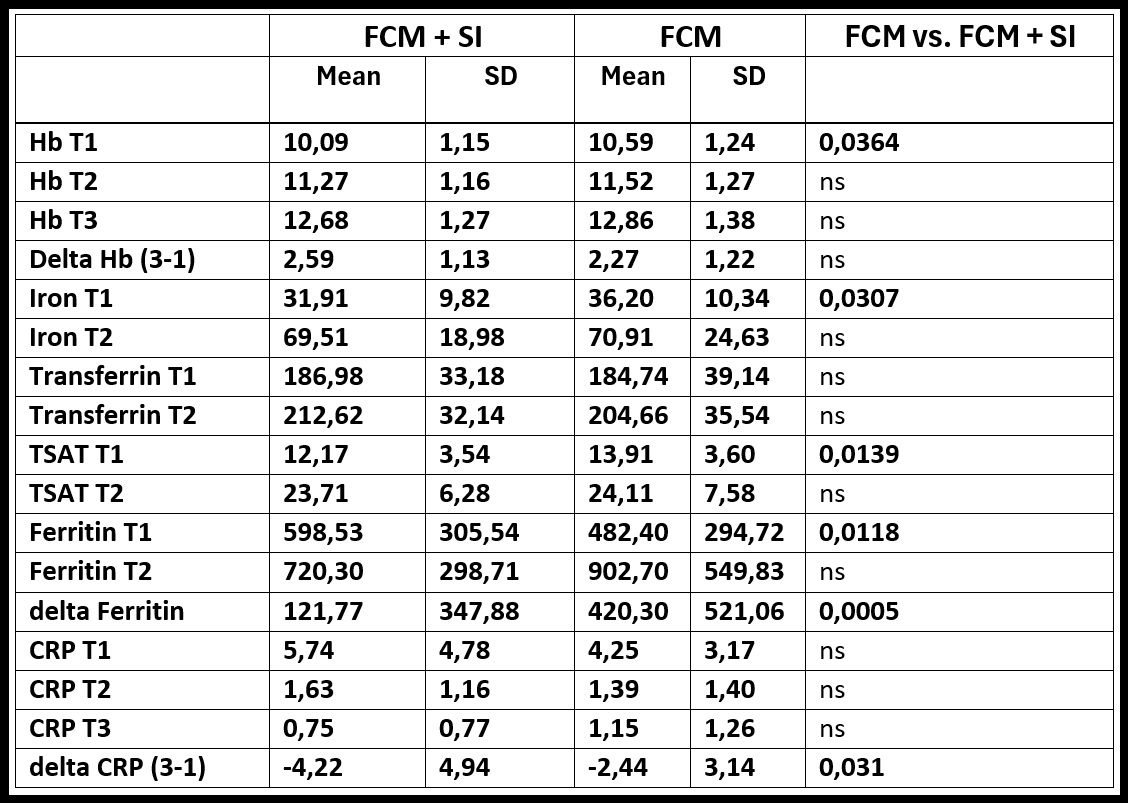
Background: intravenous ferric carboxymaltose (FCM), may increase the risk of oxidative stress and cardiomyocyte toxicity, through direct entry into the cell, bypassing the physiological reticuloendothelial system pathway. Oral SI compared to FCM, after cardiac surgery (CS), was able to induce a similar improvement in key hematological parameters (HP) reducing ferritin (F). Aim of the study was to evaluate whether the dual therapy can mitigate the rise of F and C-reactive protein (CRP). Methods: 104 consecutive patients (P) admitted to cardiac rehabilitation, after CS, with iron deficiency anemia IDA (mean age 71.3 ± 8.9 years), with normal ventricular function (EF: 54.5 ± 6.3), were all treated with FCM (group A) and a portion (group B, n = 52) also with SI. The study design included a single dose of 1000 mg of FCM at T1 (8–10 days after CS) and then a dose of 60 mg of SI daily to T2 (the day of discharge) until T3, 15 days later. Efficacy measures: changes from baseline in HP and CRP. Results: Statistical analysis was performed with the non-parametric Mann-Whitney test (see Table for results). Hb increased significantly, with no differences between the two groups, as did transferrin saturation (TSAT) and serum iron (I). However, Hb, TSAT were significantly lower at T1 in group B with a greater increase in Δ (for Hb (g/dl) 2.59 and 2.27, for TSAT (%) 11.54 and 10.20, I (µg/dl) 37.6 vs. 34.71, respectively in the group B vs. A). Also, basal F was higher in group B. At T3 its level was lower in the B group with a statistically lower increase in ΔF (121.77±347.88 (B) vs. 420.30±521.06 (A) ng/ml, p.0005). This translated into a 20% increase in F vs. 87% in group A. Basal CRP was higher in group B, with no difference at T3, but with a significantly higher decrease in ΔCRP for dual therapy (-4.22±4.94 (B) vs. -2.44±3.14 (A), p.031). See the figure describing the time course of F. Conclusions : FCM rapidly corrects HP, but abruptly increasing the I, can stimulate its deposition in the form of F, activating macrophages through the release of cytokines. The end result is exacerbation of the inflammation after CS. SI can mitigate the increase in F and CRP strengthening the reticuloendothelial pathway, thus reducing oxidative stress on the myocardium. Although sequential therapy has not induced final significant improvement of other HP, the lower baseline levels of IgG, Hb, and TSAT suggest the possibility that it may promote more rapid resolution of IDA .