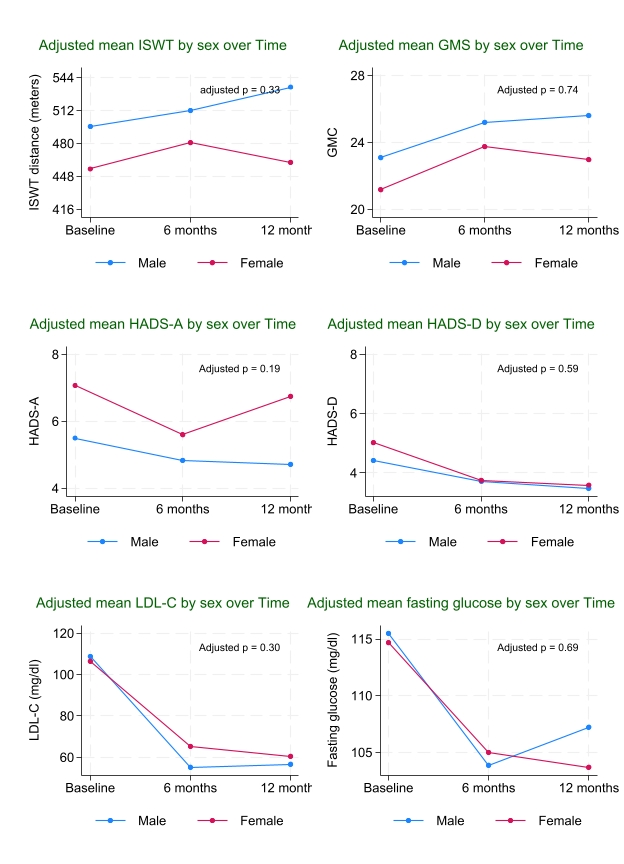
Background: Sex-related differences may influence functional, metabolic, and psychological recovery during cardiac rehabilitation (CR) following cardiac intervention; however, longitudinal data simultaneously addressing these domains remain limited. Methods: In this prospective cohort study, 179 enrolled in a structured 1-year CR program after cardiac intervention (surgical or percutaneous) were evaluated at baseline, 6 months, and 12 months. Functional capacity was assessed using the Incremental Shuttle Walk Test (ISWT). Psychological outcomes included anxiety and depression (Hospital Anxiety and Depression Scale) and positive mood (Global Mood Scale, GMS). Metabolic outcomes included LDL-cholesterol and fasting glucose. Linear mixed-effects models examined the effects of time, sex, and time × sex interaction, with patient as a random intercept, adjusting for age, diagnosis, smoking status, blood pressure, waist circumference, baseline metabolic values, and baseline ISWT. Results: Functional capacity improved significantly at 12 months (ISWT +38.3 m vs baseline; p = 0.001), with no sex-specific differences in recovery trajectories (time × sex p = 0.33). Women exhibited lower adjusted ISWT values across follow-up (baseline 455.3 m vs 496.6 m in men). Anxiety and depression decreased significantly over time (HADS-A: −0.67 at 6 months, p = 0.021; −0.78 at 12 months, p = 0.009; HADS-D: −0.69 at 6 months, p = 0.006; −0.94 at 12 months, p < 0.001), with parallel improvements in both sexes (time × sex p > 0.19). Women showed consistently higher anxiety levels throughout follow-up. Positive mood improved similarly in men and women (GMS +2.12 at 6 months and +2.52 at 12 months; both p < 0.001; time × sex p = 0.74). LDL-cholesterol and fasting glucose decreased markedly during CR (all p < 0.001), without sex-specific trajectories. Conclusions: Cardiac rehabilitation is associated with significant functional, metabolic, and psychological benefits over one year. Sex differences primarily reflect baseline disparities rather than differential recovery patterns, underscoring the importance of early functional assessment to optimize individualized CR strategies.