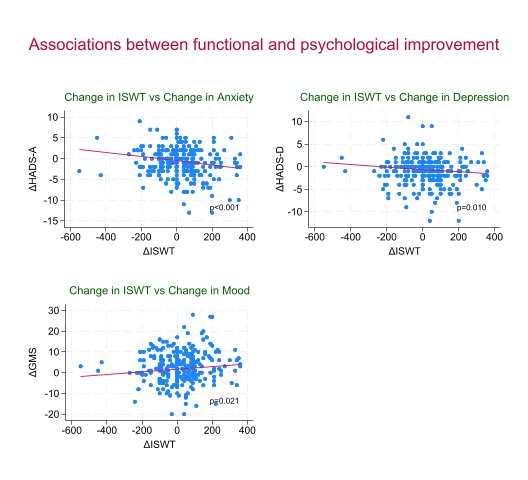
Background: Cardiac rehabilitation (CR) improves exercise capacity and psychological well-being after cardiac interventions; however, determinants of functional and psychological recovery and their inter-relationship over time remain incompletely defined, particularly across different cardiac diagnoses. Methods: In this prospective longitudinal study, patients with coronary artery disease (CAD) or valvular heart disease (VHD) enrolled in a structured 1-year CR program in 2023, were evaluated at baseline, 6 months, and 12 months. Functional capacity (FC) was assessed using the Incremental Shuttle Walk Test (ISWT). Psychological outcomes included anxiety and depression, measured by the Hospital Anxiety and Depression Scale, and positive mood, assessed by the Global Mood Scale (GMS). Longitudinal trajectories were analyzed using linear mixed-effects models with time, diagnosis, and time × diagnosis interaction as fixed effects and patient as a random intercept, adjusting for baseline demographic, clinical, metabolic, and functional variables. Associations between changes in ISWT and psychological outcomes were explored using change-score analyses. Results: Exercise capacity improved significantly over time, with an increase in ISWT at 12 months (adjusted p=0.013), independent of diagnosis (time × diagnosis p=0.35). Anxiety and depression scores decreased significantly (all p < 0.01), while positive mood increased over time (p< 0.001). Baseline FC emerged as a robust independent determinant of recovery. Higher baseline ISWT was associated with greater functional performance at follow-up (β= 0.78; 95% CI 0.69–0.87; p<0.001) and more favorable psychological trajectories, independently predicting lower anxiety (β= −0.004; p=0.018) and depression (β= −0.004; p=0.006). Improvements in ISWT over 12 months were associated with concurrent reductions in anxiety (p< 0.001) and depression (p=0.010), and with improved positive mood (p=0.021). Older age and female sex independently predicted lower exercise performance, while female sex was also associated with higher anxiety; other clinical variables showed weaker or borderline associations. Conclusions: Cardiac rehabilitation is associated with parallel improvements in functional capacity and psychological well-being over one year, irrespective of cardiac diagnosis. Baseline functional status is a key determinant of recovery, supporting integrated functional and psychological assessment within comprehensive CR programs.