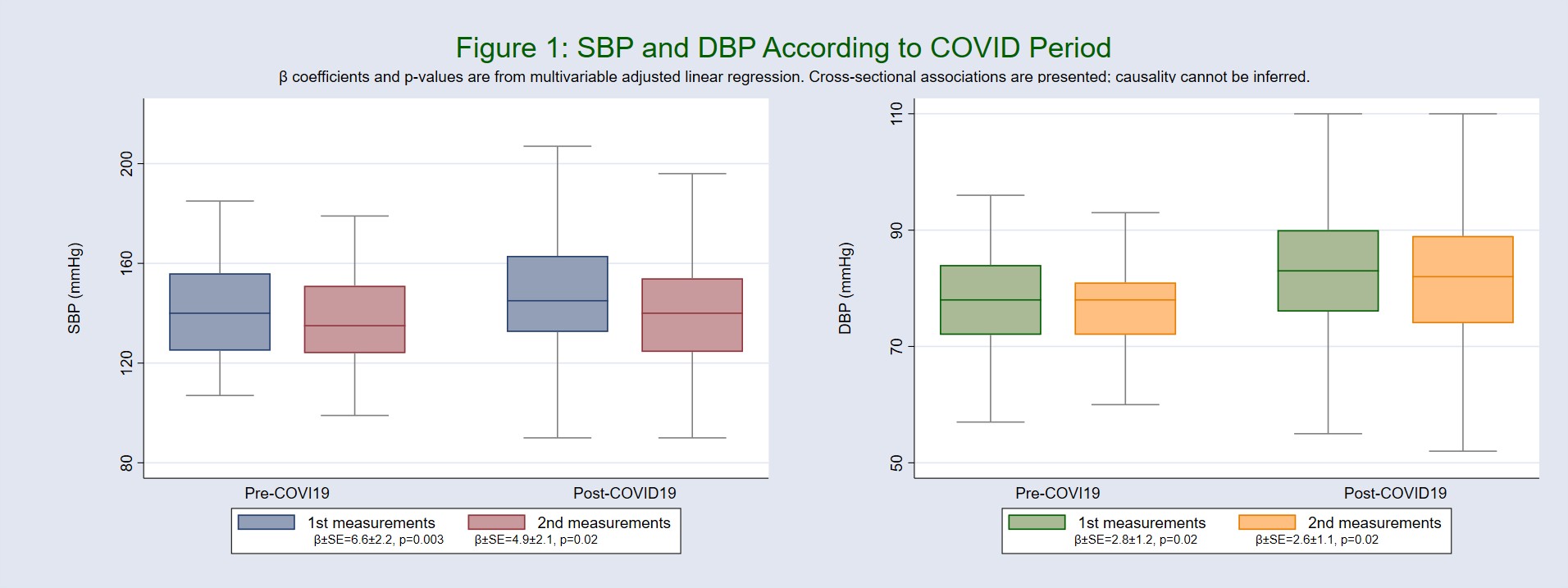
Background The COVID-19 pandemic has had long-term effects on cardiovascular health and behavior. In a real-world outpatient setting, we examined how the post-COVID period is associated with changes in blood pressure, physical activity, and stress status. Methods We analyzed data from 472 cardiovascular outpatients enrolled between 2018 and 2024. Patients were categorized into pre-COVID (n = 130) and post-COVID (n = 342) groups. Outcomes included resting heart rate (RHR), systolic (SBP) and diastolic (DBP) blood pressure (two timepoints each, 5 minutes apart), physical activity status (yes/no), and stress status (yes/no). We performed t-tests and chi-square tests for univariate comparisons and multivariable linear and logistic regressions adjusted for age, sex, and antihypertensive therapy (beta-blockers, calcium channel blockers, ACE inhibitors). Statistical analysis was performed using Stata 18 (StataCorp, College Station, TX, USA). Results The mean age was 66.7 ± 15.5 years, with 44% females. Mean SBP and DBP were 147.9 ± 22.4 mmHg and 80.8 ± 11.3 mmHg, respectively, and mean heart rate was 72.9 ± 13.8 bpm. Compared to the pre-COVID group, post-COVID patients had significantly higher blood pressure (SBP1: β±SE=6.6 ± 2.2 mmHg, p = 0.003; SBP2: β±SE=4.9 ± 2.1 mmHg, p = 0.02; DBP1: β±SE=2.8 ± 1.2 mmHg, p = 0.02; DBP2: β±SE=2.6 ± 1.1 mmHg, p = 0.02) in fully adjusted models. Physical activity was less frequent post-COVID (from 68% to 53%, p = 0.002), and logistic regression confirmed an independent association (OR = 0.51 ± 0.11, p = 0.002). Lower physical activity was also independently associated with higher stress perception (OR = 0.64 ± 0.13, p = 0.03). No significant differences in heart rate between pre- and post-COVID were observed. Conclusion In a cardiovascular outpatient cohort, the post-COVID period was independently associated with increased blood pressure and reduced physical activity. Moreover, reduced physical activity was linked to increased stress status. These findings highlight the long-lasting physiological and behavioral impact of the pandemic, and the importance of restoring healthy lifestyle habits in at-risk populations.