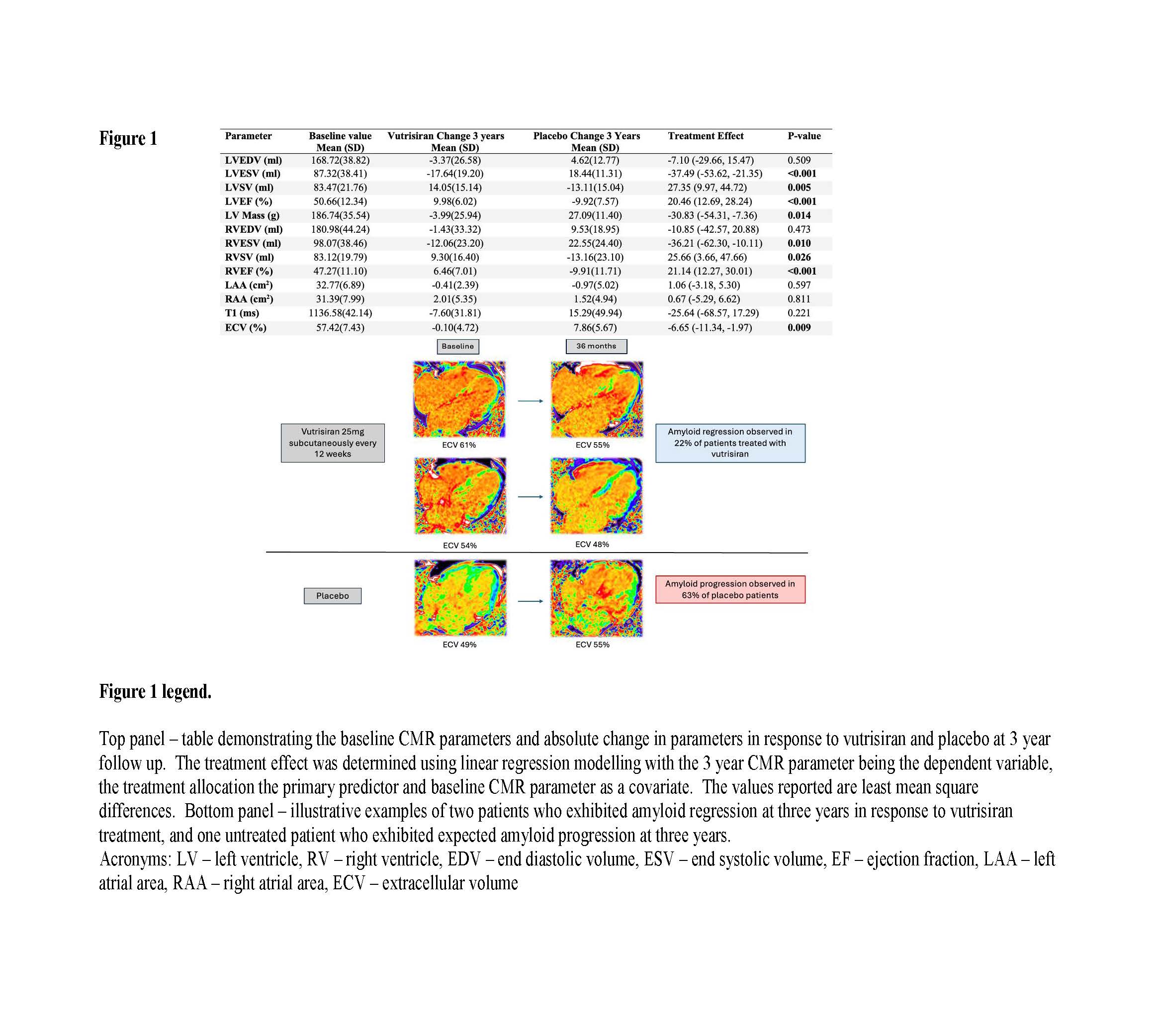
Background : ATTR-CM is caused by extracellular deposition of amyloid in the heart. Vutrisiran, an RNAi therapeutic, rapidly suppresses the hepatic production of TTR, reduces the risk of CV events and ACM among patients withATTR-CM and preserves functional capacity, health status and QoL. The present analyses evaluate the impact of vutrisiran on cardiac structure, function and amyloid load measured by cardiovascular magnetic resonance(CMR) with extracellular volume(ECV) mapping, within HELIOS-B(H-B) participants. Methods : In H-B, patients withATTR-CM were randomized 1:1 to vutrisiran (25mg subcutaneously every 12weeks)or placebo. The H-B population comprised participants who underwent serial CMR assessments at the National Amyloidosis Centre as a part of their routine clinical care. CMRs were conducted at baseline/dosing, 1-year,2-year and 3-year time points during the H-B study period. Image analysis was blinded to treatment allocation. Amyloid regression and progression were defined as an absolute reduction and increase in ECVof > 5%, respectively. Changes in CMRparameters between baseline and follow-up were evaluated, and linear regression modelling was used to determine treatment effects. Results : 43patients (mean(SD)age75.0(5.67)years, 41/43male) underwent baseline CMR(21vutrisiran, 22placebo). 39(21vutrisiran, 18placebo), 26(14vutrisiran, 12placebo) and 17(9vutrisiran, 8placebo)patients underwent 1-,2- and 3-year CMR,respectively. No patients received background tafamidis treatment. Baseline CMR characteristics were comparable between the treatment groups. At 3years, vutrisiran led to significant increases in left and right ventricular ejection fractions(least square mean difference LVEF:+20.5%, RVEF:+21.1%; both p < 0.001), stroke volumes(LVSV:+27.4 mL, RVSV:+25.7 mL; p = 0.005 and p = 0.026,respectively), significant reductions in LV mass(–30.8 g; p = 0.014), and cardiac amyloid load(ECV –6.7%; p = 0.009) compared to placebo; vutrisiran led to improvements while placebo led to deterioration. Amyloid regression was observed in22% of vutrisiran patients, whereas no placebo patients regressed. Conversely, 63%of placebo patients demonstrated progression vs 11%for vutrisiran. Significant changes in cardiac structure and function were emergent as early as year 2. Conclusion : In patients with ATTR-CM, treatment with vutrisiran was associated with improvements in cardiac structure, function and amyloid burden compared to placebo.