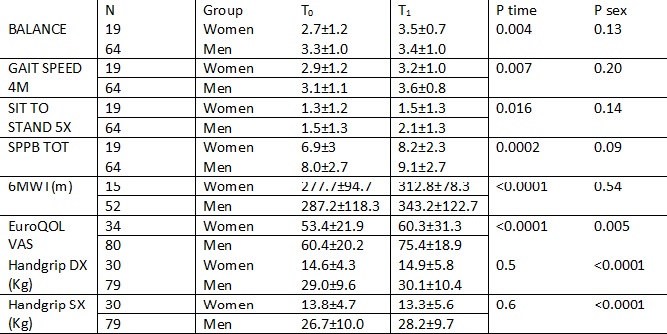
Background: Scientific research has now amply demonstrated the existence of differences between sexes in the context of different areas of exercise, in terms of physical performance, response and adaptation to exercise. Purpose: This study aimed to assess sex-related differences in baseline and post-rehabilitation test performance among patients with heart failure, and to determine the impact of sex on health status and functional recovery. Methods: The population examined comprised a total of 114 patients, 34 women(age 76.8±10.5) and 80 men(68.2±13.1). On admission and discharge, the two samples were subjected to the following assessment tests: Short Physical Performance Battery, 6 Minutes Walking Test, EuroQol VAS and Handgrip. The intake included two rehabilitation activities in the gym during the day: the first was a moderate intensity aerobic workout and the second were respiratory exercises, stretching, coordination and balance exercises. Results: The results show that the total SPPB improved significantly over time in both sexes (p=0.0002), with no statistically significant differences between sexes(p=0.09). For the 6MWT, there are statistically significant improvements between the initial and final tests in both sexes(p<0.0001), while no statistically significant differences emerge between sexes(p=0.54). In contrast, for the subjective perception of health status, the difference is statistically significant both over time for both sexes(p<0.0001) and between sexes (p=0.005). Finally, for Handgrip (bilaterally), no clinical or statistical improvements are observed over time in either sex. However, a significant difference emerges between sexes (p<0.0001), with both initial and final values in men being twice those of women. Discussion: Cardiac rehabilitation improved functional autonomy, motor performance, and exercise tolerance in both sexes, as indicated by gains in 6MWT and total SPPB scores. In contrast, the sit-to-stand and Handgrip tests showed no clinically or statistically meaningful improvement. Women’s perceived quality of life remained largely unchanged, suggesting the influence of external factors. Additionally, the number of patients able to complete the assessments differed between admission and discharge, representing a clinically relevant finding. Conclusion: Despite overall improvements, upper and lower limb muscle strength did not increase significantly, indicating the need for more targeted rehabilitation interventions for both sexes.