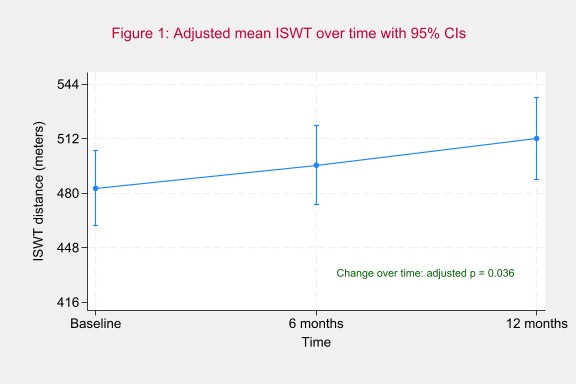
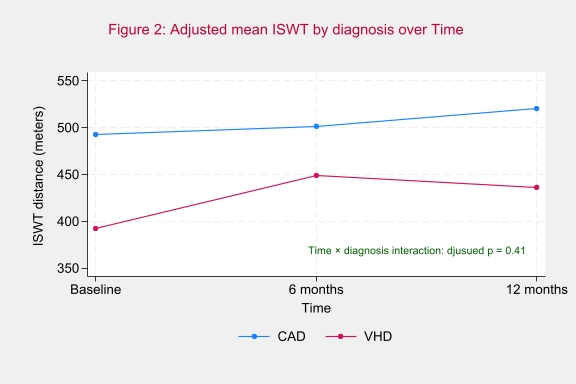
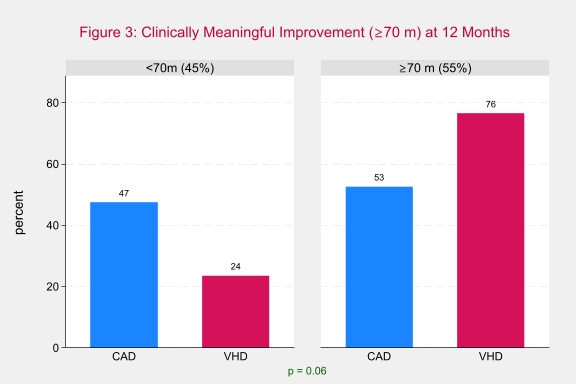
Background : Cardiac rehabilitation (CR) is essential for functional recovery after cardiac intervention, yet real-world data on longitudinal functional trajectories and differences between coronary artery disease (CAD) and valvular heart disease (VHD) patients are limited. This prospective observational study evaluated the evolution of functional capacity (FC) over 12 months in a mixed cohort of post-intervention patients enrolled in a structured CR program. Methods: We included 171 consecutive patients enrolled in our one-year CR program following cardiac intervention for CAD or VHD in 2023. Functional capacity was assessed using Incremental Shuttle Walk Test (ISWT) at baseline, 6 months, and 12 months. Longitudinal changes in FC were analysed using adjusted mixed-effects linear regression models, with time as a fixed effect and patient as a random effect. Time-by-disease interaction terms were included to evaluate differences in recovery trajectories between CAD and VHD. A clinically meaningful improvement was defined as an increase in ISWT ≥70 m. Results: At baseline, VHD patients exhibited significantly lower FC compared with CAD patients (402±202 vs 495±173 m; p=0.040). In the overall cohort, ISWT increased progressively over time, with a significant improvement at 12 months compared with baseline (+27m, 95%CI 5.0–49.8; p=0.016). After multivariable adjustment, the improvement at 12 months remained significant (+29 m, p=0.013). Although VHD patients maintained lower absolute ISWT values throughout the follow-up, no significant interaction between time and disease category was observed (p for interaction =0.35), indicating comparable recovery trajectories. At 12 months, 55% of patients achieved a clinically meaningful improvement, with a higher proportion among VHD compared with CAD patients (76% vs 53%, p = 0.06). In adjusted analysis, VHD diagnosis was independently associated with a higher likelihood of clinically meaningful improvement (β =1.38, 95%CI 0.1–2.6; p=0.032). Conclusions: Cardiac rehabilitation is associated with a significant and sustained improvement in functional capacity up to 12 months after cardiac intervention. Despite lower baseline functional capacity, patients with VHD achieve meaningful gains comparable to those with CAD, supporting the effectiveness of comprehensive CR across different cardiac disease categories.