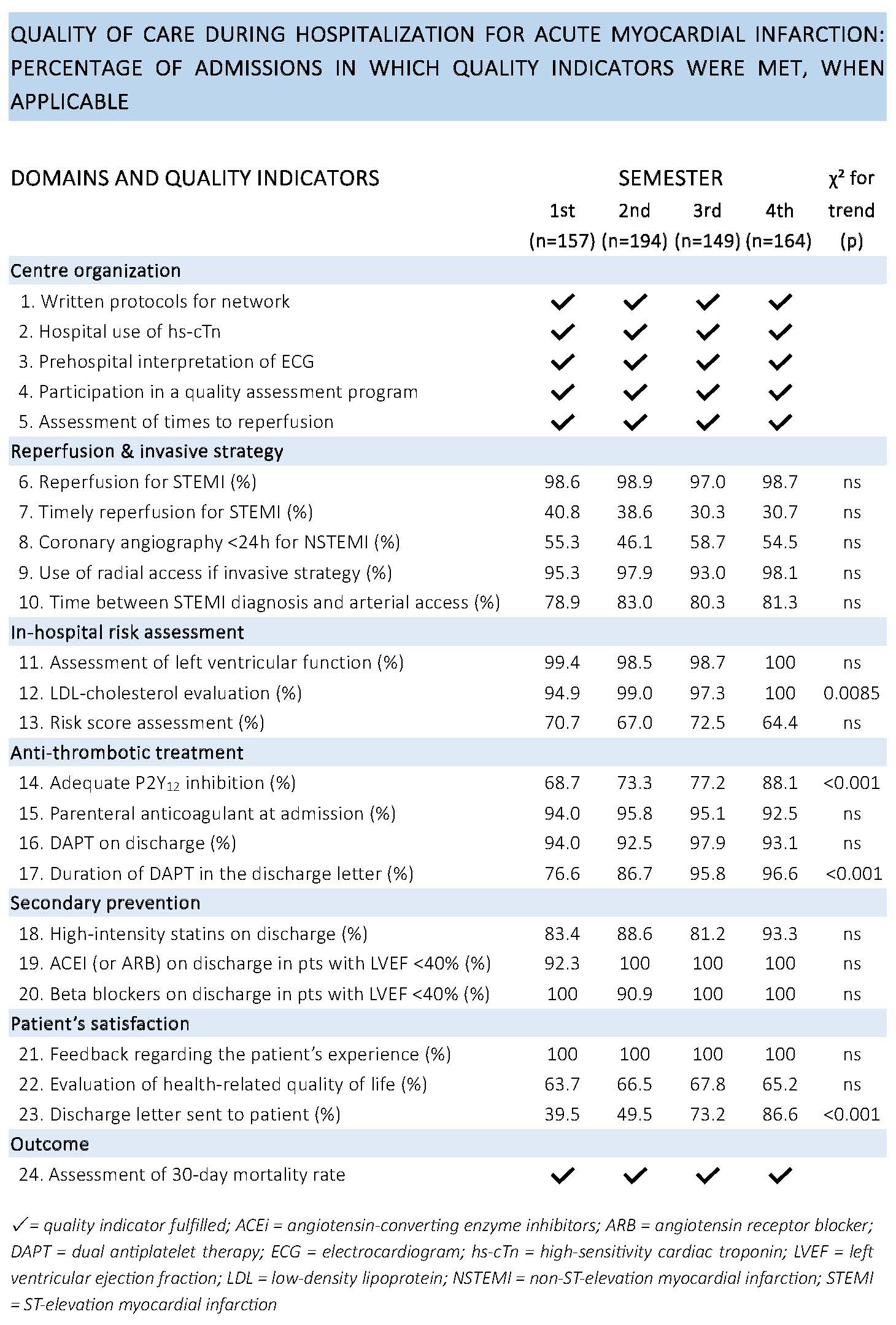
Background Assessing quality of care is the first step toward improving the management of patients with acute myocardial infarction (AMI). The European Society of Cardiology (ESC) has defined a set of quality indicators (QIs) for AMI care. Aim The “Quality in Cardiology” (QiC) Project aimed to evaluate whether systematic measurement of all ESC QIs is feasible in the cardiology department of a secondary-level hospital and whether it is useful for improving patient care. Methods The QiC Project is a prospective, 3-year observational quality improvement study conducted in the Intensive Cardiac Care Unit (ICCU) and Cardiology ward of Pio XI Hospital, Desio. For each admission for AMI, physicians and nurses completed standardized data collection forms including all ESC individual QIs (5 QIs on centre organization, 5 on reperfusion and invasive strategy, 3 on in-hospital risk assessment, 4 on anti-thrombotic treatment, 3 on secondary prevention, 3 on patient’s satisfaction, and 1 on outcome). Six-monthly audit meetings involving medical and nursing staff were held based on QI analyses. For each QI, the rate of attainment was evaluated during the first, second, third, and fourth semesters of the project among admissions ending with discharge to home or to a rehabilitation centre. Temporal trends were assessed using the chi-square test for trend, with p < 0.05 considered statistically significant. Results From May 1, 2023, to April 30, 2025, a total of 748 admissions for AMI occurred in the ICCU and Cardiology ward. One patient denied consent, 16 died during hospitalization, 67 had to be transferred to another hospital and 664 were discharged to home or to a rehabilitation centre. Table 1 shows the percentage of QIs achieved in these admissions for each semester. Of the 24 QIs, 15 were achieved in more than 90% of admissions across all semesters. Four QIs showed a significant improvement over time: LDL-cholesterol evaluation, adequate P2Y 12 receptor inhibition, duration of dual antiplatelet therapy in the discharge letter, and discharge letter sent to patient. No QIs showed a worsening trend over time. Conclusions Quality of care for AMI can be systematically measured in patients admitted to a cardiology department. Periodic audit activities enable identification of critical issues and contribute to improving the quality of care over time.