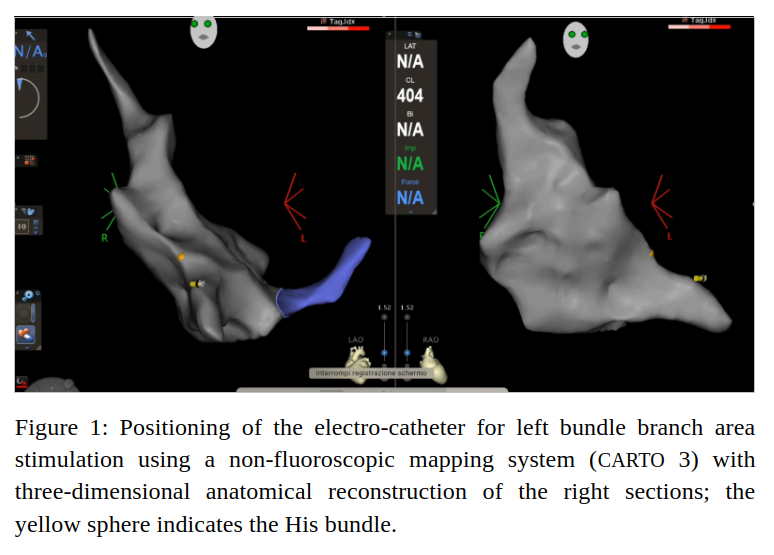
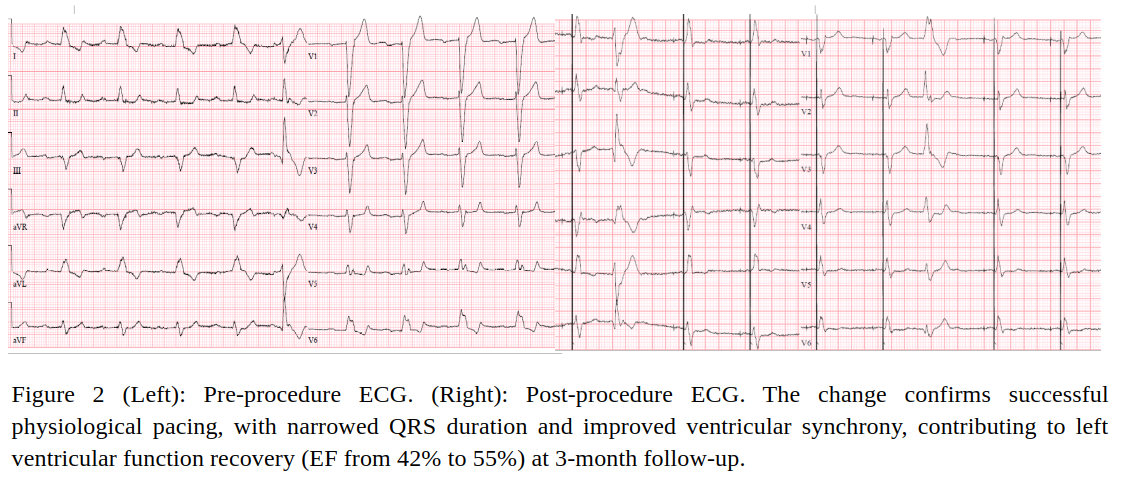
Introduction Left bundle branch area pacing (LBBAP) can involve significant radiological exposure. Electroanatomic mapping with CARTO 3 system (Biosense Webster©) has proven useful for pacemaker implantation without fluoroscopy. Clinical Case A 65-year-old patient with chronic ischemic heart disease, following percutaneous myocardial revascularization. admitted for syncope without prodromes. He previously underwent radiotherapy for lung adenocarcinoma with subsequent radiodermatitis of the axillary cavity and left hemithorax. Findings included: ECG showing sinus rhythm with left bundle branch block (QRS 150 ms); echocardiogram revealing moderate left ventricular dysfunction (EF 42%) due to diffuse hypokinesia; no significant coronary stenoses at coronary angiography; electrophysiological study negative for induction of sustained ventricular arrhythmias, but showing pathological supra- and infra-Hisian conduction (AH interval 155 ms, HV 80 ms). Considering the indication for pacemaker (PM) implantation, the left ventricular dysfunction, and the need to avoid X-ray exposure, left bundle branch area pacing (LBBAP) was performed guided by a non-fluoroscopic mapping system (CARTO 3). A three-dimensional anatomical reconstruction of the right atrium/His bundle/right ventricle was created using a decapolar catheter (DECANAV Biosense Webster©) introduced via left axillary vein. Then, a lead (Medtronic Capsure-Sense 4574-53) was positioned in the right atrial appendage and another one lead (Medtronic Select Secure 3830-69 cm), advanced through a fixed-curve sheath (C315His), was screwed in 1.5 cm anteriorly and inferiorly to the His bundle. The final ECG showed stimulated QRS morphology with positive terminal deflection (rSR pattern) in V1, QRS duration 110 ms, and V6 R-Wave Peak Time (V6RWPT) 70 ms. Regarding the electrical parameters: ventricular capture threshold was 1.5 V @ 0.4 ms, R-wave >10 mV, impedance 550 Ω. No complications. Three months after pacemaker implantation, complete recovery of left ventricular systolic function (EF 55%) and stability of the pacemaker's electrical parameters were documented. No further progression of radiodermatitis. Conclusions Pacemaker implantation with LBBAP using non-fluoroscopic electroanatomic reconstruction is safe and effective, and, beyond selected cases, could be used to reduce radiological exposure for patients and operators.