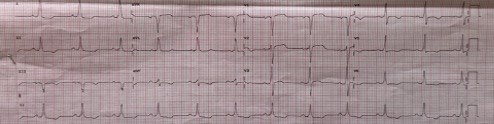
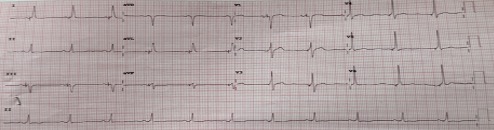
Background : Electrocardiographic diagnosis of acute myocardial infarction (AMI) during cardiac pacing is challenging. The original Sgarbossa criteria, validated for left bundle branch block and right ventricular pacing, have not been evaluated in the newer setting of conduction system pacing (CSP), where the pacing stimulus directly activates the His–Purkinje system. To date, there are no recommendations on ECG criteria for AMI during CSP. Case presentation : We describe a 74-year-old hypertensive woman with recurrent traumatic syncopal episodes and documented bradycardia, admitted to the emergency department. The ECG showed complete atrioventricular block and she was transferred to our ICU and treated with EV isoprenaline. Echocardiography revealed preserved left ventricular ejection fraction and mild aortic stenosis. In anticipation of the high burden of ventricular pacing we opted for the implantation of a PM with Hisian pacing. After the procedure, sudden agitation was followed by arterial hypotension. Echocardiography revealed a non-tamponading pericardial effusion, which rapidly increased, together with new repolarization abnormalities during His-bundle pacing. In particular, we noted a subtle ST-segment elevation in V1 and V2 of about 1 mm. The patient underwent urgent pericardiocentesis with drainage of 200 mL of blood fluid followed by prompt clinical improvement. Subsequent venography excluded perforation with active pericardial bleeding. Persistent ECG changes led to coronary angiography, which demonstrated a functionally critical mid-proximal LAD stenosis successfully treated with a drug-eluting stent. Conclusion : The diagnosis of myocardial infarction is complex in cases of pacemaker-induced rhythms. Currently, there are no dedicated algorithms for the diagnosis of acute coronary syndrome in patients treated with physiological pacing. Our case highlights that Hisian pacing may reveal subtle repolarization alterations that would normally go undetected.