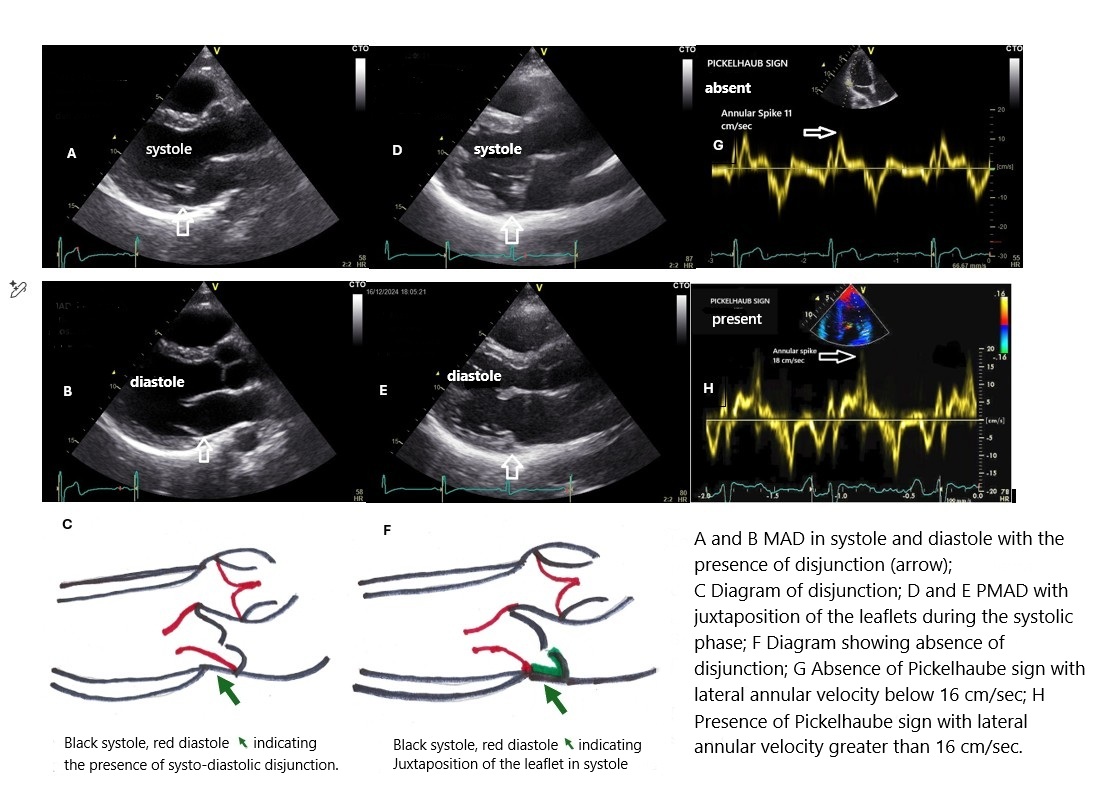
Aim of the study : To evaluate arrhythmic risk in a group of young athletes with Mitral Valve Prolapse (MVP) by analyzing the correlation between arrhythmic events and specific echocardiographic markers, particularly Mitral Annular Disjunction (MAD), pseudo Mitral Annular Disjunction (PMAD), and the Pickelhaube sign (PS). Methods : Eleven athletes aged 15 to 28 years (6 males, 5 females) with a diagnosis of MVP were studied. All subjects underwent echocardiography (Echo), ECG Holter monitoring, and exercise testing. The echocardiogram specifically assessed: MAD, defined as an abnormal systolic–diastolic separation between the mitral annulus and the left ventricular myocardium, typically located in the posterior wall; PMAD, showing separation limited to the systolic phase, and therefore appearing due to the juxtaposition of the posterior leaflet to the atrial wall, whereas MAD results from an actual atrial insertion of the annulus; PS, a systolic peak velocity >16 cm/s on Tissue Doppler Imaging (TDI) at the lateral mitral annulus; Speckle tracking (ST) with assessment of Post-Systolic Shortening (PSS), defined as systolic shortening occurring after aortic valve closure. Arrhythmic burden was evaluated through ECG Holter monitoring and exercise testing. Results : The PS was observed in 4 athletes: 2 with PMAD, 1 with MAD, and 1 with isolated MVP. Athletes positive for PS showed a higher incidence of arrhythmic events compared to those without PS. Although MAD and PMAD were associated with abnormal mechanical patterns of the mitral annulus, the PS emerged as the marker most strongly correlated with arrhythmic burden. Moreover, athletes with PS showed PSS localized in the infero-posterolateral segments. Discussion : The observed correlation between arrhythmic burden and PS may be attributed to PSS. It is known that PSS is a marker strongly associated with adverse clinical events, as widely documented in ischemic heart disease. This parallel suggests that PSS may be one of the mechanisms through which PS contributes to increased arrhythmic vulnerability in subjects with MVP. Conclusions : In our cohort of young athletes with MVP, the presence of the Pickelhaube sign represents the main echocardiographic indicator associated with an increased arrhythmic risk. Including its assessment in the screening protocol for athletes with MVP may improve risk stratification and guide clinical follow-up.