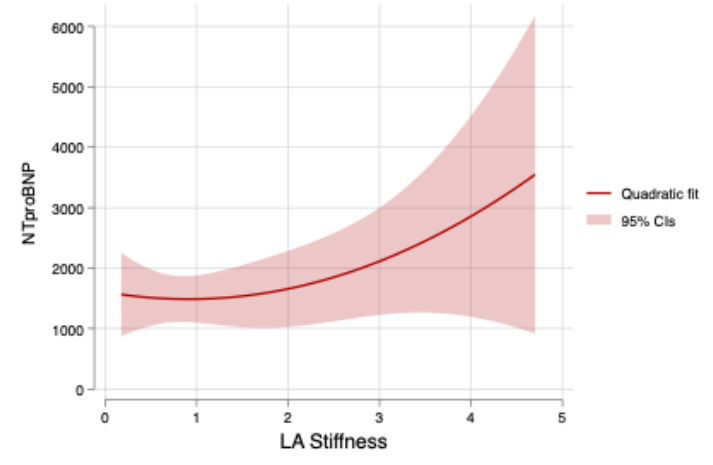
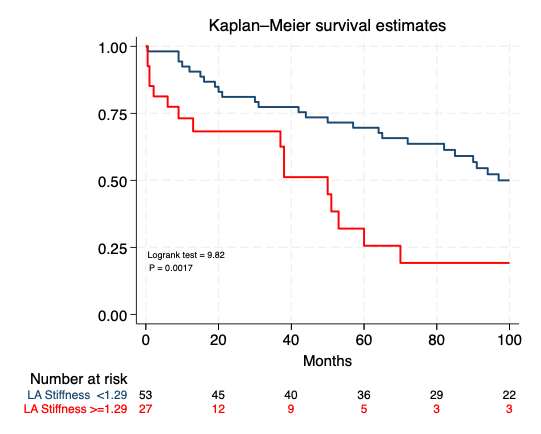
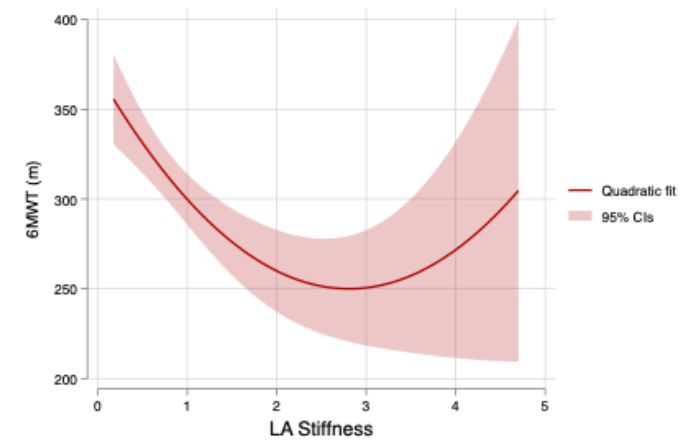
Background : Heart failure with preserved ejection fraction (HFpEF) is a complex condition associated with high morbidity and mortality. Key pathophysiological contributors include exercise intolerance, left atrial stiffness (LAS) reflecting atrial remodeling and diastolic dysfunction, and natriuretic peptides, established markers of cardiac stress. Exercise intolerance is a hallmark of HFpEF but remains poorly linked to structural and biochemical markers. Objective : To investigate the interrelationship and prognostic significance of LAS, exercise intolerance, and natriuretic peptide levels in HFpEF patients. Methods : We retrospectively studied 80 patients (mean age 72.8 years) with HFpEF. Left atrial (LAS was estimated by the ratio of E/e’/peak LA longitudinal strain (PALS) (% -1 ) measured by 2D speckle tracking echocardiography. N-terminal pro-brain-type natriuretic peptide (NTproBNP) was measured. Patients also completed a six-minute walking test (6MWT). Associations between these parameters and clinical outcomes were analyzed, with the primary outcome being death from any cause. The H2FPEF score was also calculated. Results : Higher LAS was positively correlated with elevated NTproBNP (r = 0.25, p < 0.05) and inversely correlated with 6MWT (r = -0.39, p < 0.001). Over a mean follow-up of 48.5 months, 45 patients died. At univariable analysis, LAS (HR 1.92, 95%CI 1.28 – 2.87) and 6MWT (HR 0.99, 95%CI 0.98 – 0.99) were significantly associated with the outcome (P<0.01 for both). Patients with combined high LAS, low exercise tolerance, and elevated natriuretic peptides had the highest incidence of adverse outcomes (20.3 per 100 patients/year). LAS added incremental prognostic value beyond a model containing age, gender and H2FPEF score (Likelihood-ratio test = 9.18, p = 0.0024). Conclusion : LAS, exercise intolerance, and natriuretic peptides are interconnected markers of disease severity in HFpEF. Their combined evaluation may enhance risk stratification and guide targeted therapeutic interventions.